

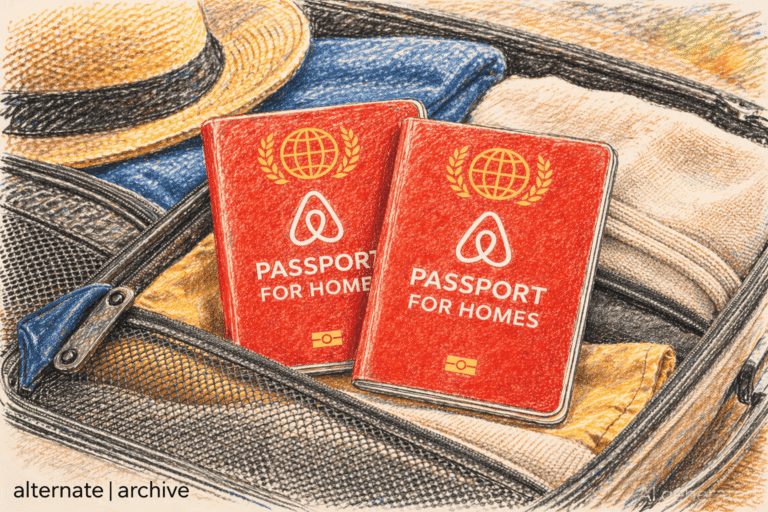
A concept document. The idea is fictional. The problem it solves is real.
At sufficient scale, every Airbnb listing starts to look like every other Airbnb listing. Location, price, and photos carry most of the decision. The platform has no mechanism to distinguish between a coastal cottage in Maine and a converted barn in Burgundy. Both live in the same review format, the same booking flow, the same five stars out of five.
There was also a second problem. Guests who had memorable stays were not attributing the memory to Airbnb. The platform facilitated the experience. The experience belonged to the property, the host, and in some cases a neighbour named Gerald who became load-bearing to the retelling. Airbnb was receiving operational credit at best.
The Passport was a physical booklet issued at check-in. Each property received a unique stamp reflecting its character. A lighthouse for a coastal property, a windmill for a Dutch conversion, a cactus for an Arizona dome. Guests accumulated stamps across stays. The booklet became a record.
Airbnb absorbed the cost. No fee to guests, no charge to hosts. The internal argument was that the platform had spent years helping people have experiences worth remembering and had nothing to show for it. Not commercially. Emotionally. The Passport was the attempt to fix that. A memory banking system for a company that had accidentally become one of the largest producers of memories on earth and had never once leaned into it.
Finance flagged the cleaning fee optics of issuing a branded collectible alongside a $180 studio surcharge. The programme launched anyway.
Hosts began requesting stamp redesigns at a rate that required a formal review queue by week six. The stamp introduced a competitive surface nobody had anticipated. Several hosts in the Netherlands pursued reclassifications to reflect windmill authenticity.
Then guests started routing trips around stamp acquisition rather than destinations. The Passport did not create that behaviour. It formalised it, made it legible, and gave people a vocabulary for describing it to others. Fourteen windmill properties developed waitlists. Scarcity became visible, which made it desirable, which made it more scarce.
Booking.com launched a competing stamp programme the following year. Functional, well-designed, competent rollout. The problem was the inventory. A stamp carries weight in proportion to the distinctiveness of the property it represents. Booking.com’s inventory includes a Mercure in Düsseldorf. This is not a criticism of the Mercure.
Guests began formally contesting stamp classifications. The most active dispute category involved dome structures. Airbnb now requires a classification process it did not previously require and does not particularly enjoy having. There are four active subreddits dedicated to Passport collection. One guest received a tattoo of their first stamp. No action was taken or required.
What the Passport actually did was give people a reason to keep going. Not just to find somewhere to sleep. To build something. A record of places they had been, experiences that had cost them something, mornings that were different from the morning before. The booklet sat on a shelf and meant something. That is not a small thing.
The decision of where to go next was often made before the app was opened, during a conversation in which someone described a stay in enough detail that the person listening opened a tab. Friends compared collections. Strangers on the internet argued about what counted. A woman in her seventies collected her twelfth stamp at a farmhouse in Provence and posted a photograph of the booklet with no caption at all, which got more engagement than anything she had ever posted.
That conversation is the product. It has always been the product. The Passport gave it a physical form and gave the people having it something to show for it. Memories became more tangible, more shareable. There was more purpose in exploring.
The cleaning fee remains $180 for a studio apartment.
Sources
The Passport programme, all outcomes, classification disputes, subreddits, and the tattoo are invented. All facts below are real.
Airbnb scale. Over 7.7 million active listings globally as of 2024. [Airbnb Inc., 2024 Annual Report.]
Cleaning fees. Airbnb cleaning fees and their effect on booking behaviour. [Various consumer and hospitality press, 2023 to 2025.]