

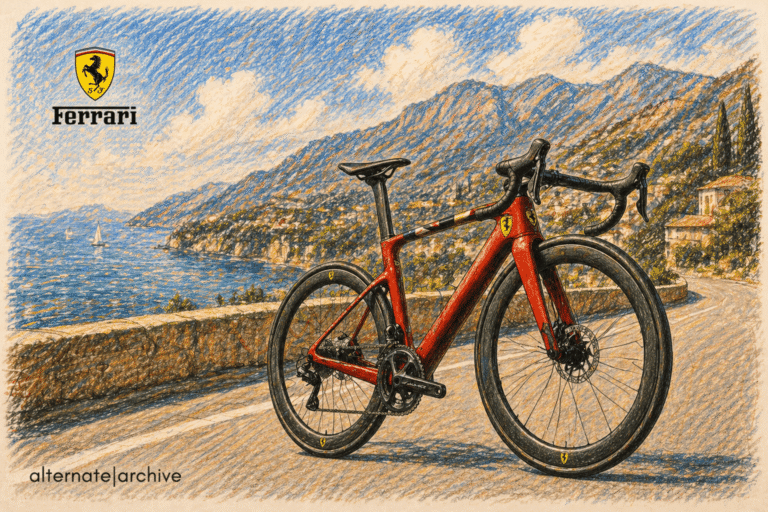
A concept document. The idea is fictional. The problem it solves is real.
The owner of four Ferraris said it was the first time he had used a vehicle at its actual capacity on a public road. The vehicle was a bicycle.
Ferrari’s factory sits in the Po Valley. It is one of the flattest places in Europe. The road past the factory gates has a 50 kilometre per hour speed limit. The cars built 200 metres back from that road are capable of 330. Ferrari has known this since 1947. The Fiorano test circuit exists one kilometre from the factory precisely because the surrounding roads cannot deliver what the cars are built for.
The Apennines are visible from Maranello on a clear day. The road to Abetone climbs into the mountains 30 minutes south. Monte Cimone, the highest peak in the Emilian Apennines, is 80 kilometres away. These are not abstract mountains chosen for drama. They are the mountains Ferrari has been looking at for 70 years while building cars that cannot use them.
A Ferrari 296 GTB produces 830 horsepower and reaches 100 kilometres per hour in 2.9 seconds. The legal speed limit on most public roads in Ferrari’s major markets sits between 100 and 130 kilometres per hour. The car’s operating range begins approximately where the law ends.
Project Veloce started from a single question: was there a product category where Ferrari’s actual promise could be delivered without a booking form.
Ferrari and Colnago had worked together since 1986, applying Formula One carbon fibre technology to bicycle frames. Colnago is not a peripheral name. Eddy Merckx set the world hour record in 1972 on a Colnago frame. The Union Cycliste Internationale sets the minimum weight for professional racing bicycles at 6.8 kilograms. Ferrari Advanced Technologies built a frame and fork that weighed 4.9 kilograms. The bicycle would have been illegal to race at the Tour de France. The geometry was developed in the Maranello wind tunnel. The finish was Rosso Corsa. There was no badge.
499 units. Each collected at Maranello, each accompanied by a half-day session with the Advanced Technologies team. Owners left understanding what they were holding. The production run sold out in 11 days. Ferrari had not advertised the programme.
The route out from the factory ran south through the valley and up into the Apennines. Flat for the first 20 kilometres. Then the road began to climb. There is no speed camera on the descent from Monte Cimone. No licence required. The same owner who had driven four Ferraris within the constraints of a motorway network found, on a mountain 30 minutes from where those cars were built, the thing those cars had been promising him for years.
Within six weeks, 61 owners had descended Apennine passes.
Within three months it had produced something the programme had not anticipated. Cycling publications ran identification pieces. One concluded it was a Colnago prototype. Another attributed it to a boutique Swiss manufacturer that does not exist. Ferrari did not correct either account.
Following the coverage, 4,200 expressions of interest arrived for a second production run that had not been announced. No price had been stated.
What the bicycle gave people was not speed. It was the mountains on Ferrari’s doorstep that the car had never been able to reach properly. The Appennino Modenese is not a private track. There is no booking form. The road belongs to anyone willing to climb it, and on a clear morning in September it is full of people doing exactly that. Cyclists from Modena, from the valley, from Maranello itself, ascending the same roads that run behind the most famous car factory in the world. At the top, nobody is a Ferrari owner or not a Ferrari owner. They are just people at the top of a mountain, about to descend.
The owner of four Ferraris had never had that before. Most people never do.
Sources
Project Veloce, the production run, and all associated outcomes are invented. All facts below are real.
Ferrari factory location. Maranello, Province of Modena, Emilia-Romagna. Fiorano Modenese test circuit adjacent to factory. [Ferrari S.p.A. company history.]
Ferrari and Colnago collaboration. Ernesto Colnago collaborated with Ferrari S.p.A. from 1986, applying Formula One carbon fibre technology to bicycle frames. The C35, released in 1989, was the first major product of the collaboration. [Colnago company history.]
Eddy Merckx hour record. Set October 25, 1972, Mexico City velodrome, on a Colnago frame. The record stood until 1984. [UCI, hour record history.]
Ferrari 296 GTB. 830 horsepower combined output, zero to 100 kilometres per hour in 2.9 seconds. [Ferrari S.p.A., official specifications.]
Ferrari deliveries. Ferrari delivered 13,663 cars in 2023. [Ferrari S.p.A., full year results 2023.]
UCI minimum weight. The Union Cycliste Internationale sets the minimum weight for professional racing bicycles at 6.8 kilograms. [UCI Technical Regulations.]
Appennino Modenese. Monte Cimone is the highest peak in the Emilian Apennines at 2,165 metres, approximately 80 kilometres from Maranello. [Geographic sources, various.]